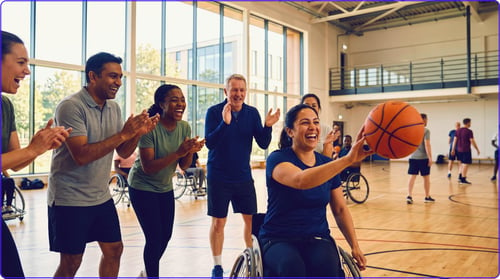
A colleague in a wheelchair, a visible disability card, an obvious workstation adjustment: that's the image most HR teams picture when disability at work comes up. The problem is that this image is wrong in the vast majority of cases.
According to Agefiph, France's national disability employment agency, 80% of disability situations are invisible. And 85% of them appear during someone's working life: they are not present from birth. These two figures alone explain why so many companies believe they have no affected employees at all, when the statistical reality says the opposite.
This gap between perception and reality has a name: these are myths. And they are not harmless, because they shape real decisions (hiring, internal communication, training budget) based on a false picture. We go through them one by one, along with what the law actually says and the concrete levers to act on, not just to understand.
Disability in the workplace: a far more common reality than most think
Under French law, disability is defined by Article L114 of the Social Action and Family Code as "a limitation of activity or a restriction of participation in social life suffered by a person in their environment due to a substantial, lasting or permanent impairment of one or more physical, sensory, mental, cognitive or psychological functions, a combination of disabilities, or a disabling health condition."
Behind this definition, six broad families of disability are generally recognised:
- Motor disabilities, linked to a physical impairment that makes movement or certain tasks difficult.
- Visual disabilities, corresponding to impaired eyesight.
- Hearing disabilities, corresponding to impaired hearing.
- Intellectual disabilities, associated with cognitive impairments that create learning or comprehension difficulties.
- Psychological disabilities, linked to conditions that affect emotional regulation and social relationships.
- Cognitive disabilities, which create difficulties with understanding or memory.
These categories can overlap, and their intensity varies enormously from one person to another: two people with the same diagnosis can experience very different day-to-day impacts. This diversity of situations is exactly what makes generalisations dangerous, and what feeds the myths we're about to break down.
The myths still blocking inclusion in the workplace
Four preconceived ideas come up most often in companies that haven't yet started working on disability. Here's what the reality actually looks like behind each one.
| Myth | What reality says |
|---|---|
| Disability is always visible | 80% of disability situations are invisible (Agefiph) |
| A person with a disability performs worse | No gap once the role is properly adjusted |
| Raising awareness is complicated and expensive | Agefiph support and turnkey awareness formats exist |
| Disability has nothing to do with team cohesion | Awareness works best when owned by the whole team |
Myth #1: disability is always visible
This is the founding myth, the one nearly all the others stem from. As we saw above, 80% of disability situations are invisible. Attention disorders, anxiety disorders, dyslexia, depression, bipolar disorder, fibromyalgia, endometriosis... none of these show up on a resume or in an interview, yet each of them can be recognised as a disability.
The direct consequence: a company that believes it has "no affected employees" very likely has employees living with an undeclared disability, often out of fear of being judged or sidelined. That's one more reason to build a climate where talking about it costs nothing.
Myth #2: a person with a disability performs worse
Nothing supports this idea once the role is properly adjusted. In fact, the law says the opposite: companies have a legal duty of reasonable accommodation (adjusting tasks, adapting schedules, providing equipment), precisely so that a disability has no impact on someone's ability to do the job. The "lower performance" myth almost always comes from a lack of accommodation, not a lack of skill.
Myth #3: raising awareness and training teams is complicated and expensive
This is one of the most concrete obstacles companies raise when they want to move forward but don't know where to start, between budget, team availability and the fear of getting it wrong. The reality is simpler: financial support from Agefiph exists specifically for workstation adjustments and support, and turnkey awareness formats now exist, from expert-led webinars to playful workshops, that require neither a dedicated training budget nor prior internal expertise. More on this below.
Myth #4: disability has nothing to do with team cohesion
A quieter myth, but just as limiting: treating disability as an isolated, purely compliance-driven HR topic rather than one that concerns the whole team. Awareness around disability works best when it's owned collectively, not only by HR leadership. That's exactly the angle taken for the 2026 European Week for the Employment of People with Disabilities (SEEPH), whose official theme is "Demystify, simplify, support: employment for everyone" (source: Agefiph, French-language). Demystifying is exactly what this article sets out to do.
What French law says about disability in the workplace
Beyond the myths, there is a precise legal framework, which shapes what companies must (and can) do. This framework applies to companies operating in France; other countries have their own rules.
Company obligations
- Since 2018, companies with more than 250 employees must appoint a disability officer, responsible for informing and supporting affected employees and organising awareness initiatives.
- Any company with more than 20 employees must meet a 6% quota of employees with a recognised disability.
- Companies that don't meet this quota must pay a contribution to Agefiph (private sector) or FIPHFP (public sector), which then funds professional integration initiatives.
- Accessible premises and non-discrimination in hiring and throughout a career are also part of the legal framework.
Available support
Companies aren't left to handle these obligations alone. Agefiph offers financial support to adapt workstations and support affected employees, and the French state offers hiring incentives (grants, tax credits) as well as dedicated training pathways such as apprenticeship or work-study contracts.
How to act on disability, concretely
Once the myths are cleared up and the legal framework is in place, the most practical question remains: where to start.
Raising awareness across your teams
Several formats exist to open up the topic without waiting for a concrete case in the team:
- Dedicated training programmes (for example those run by Gloria), covering both the basics of disability at work and specific topics such as autism or sign language.
- Commitment charters such as the Manifeste pour l'inclusion, launched by the Handiréseau association, which structure a roadmap (manager training, workstation adaptation, mentoring).
- Collective moments, in the form of a challenge or a webinar, which have the advantage of engaging everyone at once rather than a small group that's already convinced. More on this in the last section.
Hiring a person with a disability
A few habits help make the hiring process more reliable:
- Write an inclusive job posting, explicitly stating that candidates with disabilities are encouraged to apply.
- Post the role on specialised platforms in addition to general ones.
- Ensure interviews are fully accessible (alternatives for deaf or hard-of-hearing candidates, adapted schedules and locations for candidates with reduced mobility).
- Train the hiring team, to guarantee a welcoming, informed, and thoughtful process.
- Adapt the role and equipment once the person is hired, based on their actual needs, not a general idea of disability.
One useful reminder at every step: since 80% of disability situations are invisible, most affected candidates won't flag it themselves. It's the climate of trust built beforehand that determines whether someone feels safe enough to bring it up, or not.
Making inclusion part of the whole year
One-off awareness efforts only go so far if they aren't followed up with recurring collective moments. That's where company challenges make the real difference: they turn a topic sometimes seen as serious or anxiety-inducing into a shared, positive experience lived by every team at once. According to United Heroes' 2025 SROI report, 66% of users of collective challenges report a stronger sense of belonging, and 74% see a positive effect on their mental health. Those are exactly the two levers most often missing from a disability approach that stays confined to HR.
SEEPH 2026 and H-GAMES: a chance to act
SEEPH 2026 runs from 16 to 22 November, marking its 30th edition, co-organised by LADAPT, Agefiph and FIPHFP. DuoDay, which lets a person with a disability spend a day alongside a potential employer, takes place on Thursday 19 November.
This is the setting for H-GAMES, the inter-company competition run by United Heroes in official partnership with the French Handisport Federation (over 60 years of activity). The 6th edition takes on the angle "disability beyond appearances," directly echoing SEEPH's official theme.
The 2026 format:
- The app opens on 2 November.
- One warm-up week from 9 to 15 November, followed by two weeks of competition starting 16 November.
- A webinar on Thursday 19 November at 11:30am, hosted by Christophe Carayon, Technical Director of the French Handisport Federation, the same day as DuoDay.
- An in-person closing event on 3 December, from 3 to 6pm, at the Prisme de Bobigny near Paris, with 150 people expected around adapted sports activities: blind football, wheelchair basketball, wheelchair rugby and goalball.
This edition deliberately keeps things modest: rather than big speeches, the focus is on empathy and collective effort, through everyday gestures (clearer communication, more attentive listening, more flexible organisation). Awards recognise participating companies across several dimensions: overall ranking, rankings by company size, engagement award, social impact award, audience favourite, outreach award and legacy award.
Since its creation, the programme has raised €401,750 (donations are 60% tax-deductible) and brought together more than 170 participating companies. The 2025 edition, held at INSEP, gathered 23 companies and raised €56,750, with 150 participants at the closing olympiad.
In short: disability in the workplace is still largely seen through preconceived ideas, while the reality (80% of situations invisible, a precise legal framework, existing support) tells a very different story. The right time to act isn't when a case shows up in the team, it's before, by building a climate where the topic can be discussed normally.
To go further on building an inclusive culture more broadly, our guide DEI: what are employee expectations? details what employees actually expect. And for other SEEPH-related activity ideas, see our selection of activities for SEEPH 2026.

Product Marketing Manager @United Heroes