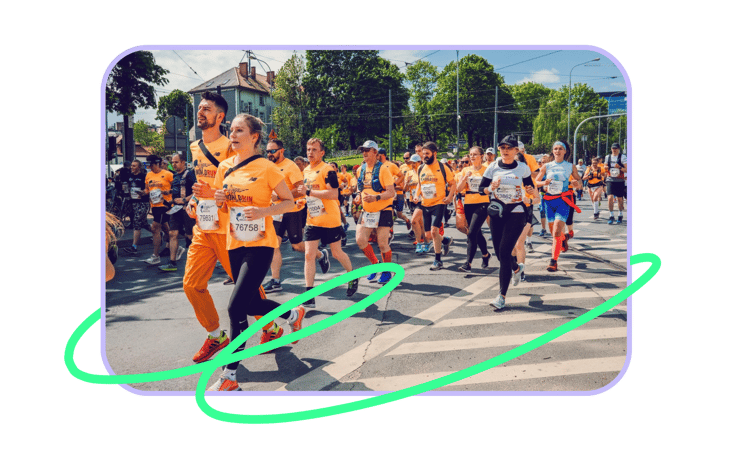
Organizing a workplace challenge remains one of the most direct ways to build connections between teams. A well-chosen employee challenge idea rallies employees around a shared goal, including those who never cross paths day to day. The format works because it turns a vague intention, moving more or acting together, into a concrete, shared experience. When well designed, it also helps strengthen team cohesion far beyond the challenge itself. Finally, it fits naturally within a living workplace well-being approach, where well-being and collective spirit are practiced rather than declared.
This article offers fifteen concrete ideas, spanning sports and solidarity, designed for a quick launch. You will then find the keys to including frontline and international teams, followed by five tips to maximize participation.
Contents
What makes a good corporate challenge
Not all challenges produce the same results. Four criteria separate a challenge that unites people from an initiative that fizzles out within ten days.
A collective goal first
A good challenge brings people together. Points accumulate at team level, not just individually. Everyone contributes at their own pace, and success is shared. This dynamic avoids turning colleagues into competitors and builds lasting mutual support.
Inclusive by design
A sports challenge fails if it only appeals to seasoned athletes. Plan varied activities, from walking to cycling to creative challenges. Reward participation rather than raw performance. Sedentary employees, remote workers, and shift workers must be able to win just like anyone else.
Effortless to measure
The rules fit in three lines. Everyone knows what counts, how it gets validated, and when it ends. A visible counter creates friendly competition without endless debates over scoring.
Short and well-paced
Two to four weeks are enough. Beyond that, attention fades and participation drops. A launch event and a closing moment keep momentum going from start to finish.
9 corporate sports challenge ideas
Here are nine proven sports challenge ideas, adaptable to your size, your roles, and your sites.
1. The daily steps challenge
Each participant aims for a daily step count, for example 8,000. Teams pool their totals and track their progress on a shared counter. Walking requires no equipment or particular fitness level, which makes it the most inclusive format. It works just as well in the office as at home or on site.
2. The great inter-team relay
The company picks an iconic route to cover in cumulative distance: connecting two offices, crossing France, circling a continent. Running, walking, cycling, and swimming all feed the collective counter. Each team moves the shared flag forward, and nobody needs to be an athlete to contribute.
3. The internal Olympic week
For five days, departments compete in short, fun events: pétanque, foosball, relays, quizzes, timed courses. Spirit matters more than performance. This format creates highlight moments that are easy to photograph and talk about, making them highly visible internally.
4. The stairs challenge
For one month, participants count the floors they climb each day. The collective total converts into altitude: scaling the Eiffel Tower, then a legendary summit. The challenge requires no budget or heavy logistics, and its effect on habits is immediate.
5. Green commuting week
Over a set week, everyone gets to work by bike, on foot, by scooter, or by carpooling. Teams tally up the clean commutes completed. This challenge connects physical activity, the environment, and the deeper issue of business travel.
6. The virtual world tour
Each team's activity kilometers advance a fictional expedition across a world map. Stage by stage, milestones reached unlock cultural or surprising content about the cities crossed. The storytelling keeps interest alive throughout the challenge.
7. The daily streaks challenge
Inspired by the streaks popularized by learning apps, the principle is to validate one micro-action every working day: five minutes of stretching, an active break, a few desk exercises. Consistency counts more than intensity. This format suits beginners who want to build a habit especially well.
8. The inter-department tournament
One sport, several weeks, group stages then a final: five-a-side soccer, badminton, table tennis, or pétanque. Matches become anticipated social occasions. Schedule varied time slots so shift workers and remote employees can take part.
9. The active break challenge
Every day, the team dedicates a few minutes to a movement break: a walk around the site, group stretches, climbing stairs. The action is validated as a group, which builds a shared routine. It is the simplest format to roll out across all sites, including industrial environments.
6 solidarity and CSR challenge ideas
Collective challenges lend themselves to social commitment just as well as to sport. If you want to expand the civic dimension, our selection of 10 solidarity action ideas usefully complements this list.
1. The inter-team collection drive
Food, toys, school supplies, or books: each team takes on a collection challenge for a partner charity. Set a target per team and a single drop-off point. The final handover becomes a unifying moment in itself.
2. Kilometers for charity
Every kilometer covered by employees converts into a donation paid by the company to a nonprofit. Sport funds commitment, and everyone progresses at their own pace. This format combines physical challenge and measurable impact.
3. The zero waste challenge
For one month, teams reduce their waste at work: reusable bottles, rigorous sorting, limited printing, giving objects a second life. Progress can be compared across sites and departments. The challenge makes CSR ambitions that sometimes feel abstract tangible.
4. The energy challenge
Switching off equipment, sensible heating and cooling, low-impact daily habits: teams adopt routines that cut building energy consumption. Results show up directly on meter readings. This challenge anchors energy conservation in everyone's habits.
5. The team solidarity day
Half a day or a full day dedicated to a field mission with a nonprofit: community farming, object repair, volunteer support. The collective effort happens outside company walls. Teams come back with shared memories that fuel cohesion long afterward.
6. The creative charity challenge
A charity quiz where every correct answer triggers a donation, an internal auction of artworks made by the teams, a pop-up shop for a good cause: creativity funds commitment. This format includes those who prefer to contribute in ways other than sport.
Launching a connected challenge: including frontline and international teams
With remote work, staggered schedules, multiple sites, and subsidiaries abroad, traditional formats struggle to bring everyone together. The connected challenge solves this problem. Everyone participates asynchronously, meaning whenever suits them, and results aggregate automatically into a shared leaderboard. A photo proof is all it takes to validate a solidarity action, and manual entry lets anyone participate without a smartwatch.
That is the role of United Heroes, a B2B mobile app that mobilizes employees around the company's strategic priorities: quality of life and working conditions, cohesion and social connection, solidarity engagement and CSR, and support for transformation. The core mechanic remains the Challenge, complemented by Streaks, daily series that encourage consistency, and by Events, short activations that mark a key moment such as a sports week. On the management side, the Client Portal lets administrators configure challenges, track participation, and communicate with teams.
The app is B Corp certified and ISO/IEC 27001 certified, covering both impact requirements and data security. Its carbon footprint ranks in the top 15% of the Greenly ranking. It is used by more than 1,000 organizations, three million users across 150 countries, and counts Paris 2024, Orange, Decathlon, LVMH, and MAIF among its public references. To explore the mechanics in detail, check out how our app works.
5 tips to maximize participation
A well-run challenge leaves behind new habits, new connections, and the desire to do it again.
FAQ
How long should a corporate challenge last?
Two to four weeks is the most effective duration. The format stays short enough to hold attention and long enough to build a habit. Punctuate the journey with a memorable launch and a friendly closing. For deeper topics like energy conservation, chain together short sequences rather than an annual marathon.
How do you include employees who don't play sports?
Plan varied activities from the outset: walking, cycling, stretching, solidarity actions, or creative challenges. Value consistency and involvement rather than performance alone. Also open up supporting roles, such as team coach, photographer, or logistics organizer. Nobody should feel excluded from the collective dynamic.
Should you plan rewards?
A reward helps, but it should serve the collective. Favor a symbolic trophy, an additional donation to the partner charity, or a shared moment such as a team breakfast. Avoid large individual prizes, which shift motivation toward personal competition. The experience lived together remains the best reward.
How do you measure the results of a challenge?
Define your indicators before launch. The most useful are the participation rate, the consistency of contributions, and the cumulative activity volume. Add a qualitative measure through a short questionnaire at the end. These elements will help you decide whether to run another edition and how to improve it.
Can you organize a challenge with international teams?
Yes, provided you adopt a connected format. Rules must stay simple and be translated if necessary, and the leaderboard must automatically aggregate contributions from all time zones. Favor activities that work everywhere, such as walking, cycling, or local solidarity actions. The United Heroes app is used in 150 countries, after all.
What budget should you plan for?
The budget depends mainly on the chosen format. A simple internal challenge mostly requires organization time and some communication. A connected platform adds a subscription, weighed against the management time saved and the reach offered to dispersed teams. Start with a limited scope, then expand if the experience convinces you.

Product Marketing Manager at United Heroes