
Contents
In short
To reduce employee isolation in remote work and shift work, HR first measures who is isolated. It then keeps regular in-person meetings, gives managers a watching brief, runs shared moments that people can join at any hour and builds links between teams that never meet.
Remote work and night or shift work have one thing in common: part of the workforce experiences the company at a distance from everyone else. Some work from home, others arrive when head office is empty. This article looks at who is affected, what the research says, the warning signs to watch and six actions to put in place. It complements our case study on multi-site team cohesion at Orano, which describes how one industrial site tackled the issue. Here, the starting point is the isolated individual.
Which employees are most exposed to isolation?
Remote workers
Remote work is now an established practice. In France, according to the national statistics institute (Insee) and the labour ministry's statistics department (Dares), 22% of private-sector employees worked remotely at least once over a four-week period in the first half of 2024. They did so for 1.9 days a week on average, mostly in a hybrid pattern. Source: Insee Analyses no. 105, March 2025 (in French).
Hybrid work reduces isolation without removing it. The risk is highest for people who work fully or almost fully remotely, and for those whose team is spread across several sites.
Shift and night workers
According to Dares, 10.6% of employees in France worked at night at least once over a four-week period in 2025. Counting everyone in employment, the share rises to 17.5% in human health, 24.8% in transport and storage, and 28.0% in the manufacture of food, beverages and tobacco products. Source: Dares, "Night work", 3 June 2026 (in French).
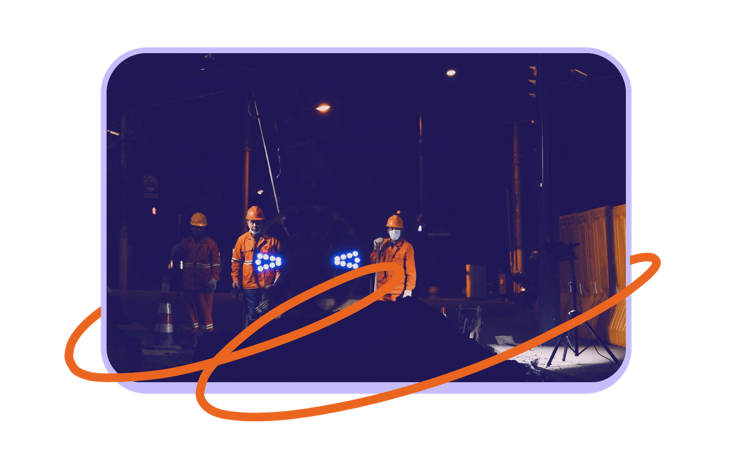
Add to this rotating shift teams, weekend work and branch or store networks with long opening hours. These employees are on site, but rarely at the same time as their day-shift colleagues or head office.
Remote work and loneliness: what the numbers say
According to Gallup's State of the Global Workplace 2024 report, one in five employees worldwide say they felt lonely a lot of the previous day. Of all the variables Gallup analysed, work location shows the biggest differences: 25% of fully remote employees report loneliness, compared with 21% of hybrid employees and 16% of those who work only on site. Source: Gallup, 11 June 2024.
In France, our 2026 HR Barometer, run with OpinionWay among 1,038 employees in January 2026, points the same way. 72% of fully remote employees go through whole days without a single informal interaction, compared with 55% of all employees. Source: United Heroes and OpinionWay, 2026 HR Barometer (in French).
Social isolation also reaches beyond work. The 2025 Fragilities Barometer by Malakoff Humanis, a French social protection group, was run by Harris Interactive among 2,060 private-sector employees and 450 business leaders in France in spring 2025. It shows that 59% of employees are going through a personal difficulty. Social isolation is one of them: it is cited by 17% of the people concerned. And 64% of the employees affected say their situation has an impact on their working life. Source: Malakoff Humanis, 15 October 2025 (in French).
Shift work: a less visible form of isolation
Isolation in remote work gets a lot of attention. The isolation of night and shift teams gets less, because these employees are physically at work.
INRS, France's national occupational health and safety research institute, describes the effects of night work on life outside work: a limited social life, with difficulty seeing friends and taking part in cultural, sports or community activities, and less time shared with a partner and family. Source: INRS, atypical working hours and health effects (in French).
The same gap appears inside the company. Briefings, team drinks, workshops and internal events take place during the day, often at head office. A night team hears about them afterwards. Over time, it can feel as if it works for a different company from the one described in internal communications.
How to spot an isolated employee
Isolation is hard to see from a distance. INRS points out that an employee working from home is potentially a lone worker, who works without being seen or heard directly by others. It calls for vigilance on distress at work, which is easier to hide when people are apart. Source: INRS, Telework, ED 6384 (in French).
A few signs deserve a manager's or HR's attention:
- an employee who no longer joins informal conversations, online or on site;
- teams or sites that have been absent from every shared moment for several months;
- questions about information that has already been shared, a sign that it is not reaching some teams;
- comments about being "forgotten" or "never in the loop".
These signs are not a diagnosis. They are a reason to start a conversation, in a one-to-one or a team meeting.
6 actions to reduce employee isolation
How United Heroes helps reduce isolation
United Heroes is a solution that brings employees together through shared experiences: challenges, quizzes and short events. It runs on a smartphone at any hour, so remote staff, night teams and distant sites can take part in the same moments.
Unilabs is one example. The medical laboratory network has more than 160 laboratories across France, with teams mostly working in the field. During challenge periods, its teams exchange more than 250 messages on average. Philippine Rossignol, Internal Communications and Company Culture Manager, puts it this way: "we can finally reach all our employees simultaneously, everywhere in France". Read the Unilabs customer story.
To go further:
- our approach to team cohesion and culture;
- our comparison of team cohesion apps;
- the workplace cohesion guide 2026, built with HR leaders.
Frequently asked questions
Does remote work make employees lonelier?
The available research suggests it does. In Gallup's global survey published in 2024, 25% of fully remote employees reported loneliness, compared with 16% of employees who work only on site. Hybrid employees sit in between, at 21%.
How do you stay connected with a night shift team?
Schedule briefings and events at times when the night team is at work, or offer formats people can join at any hour from a smartphone. From time to time, bring senior leaders and head office staff onto those shifts too.
Who is responsible for tackling employee isolation?
HR leads the approach and measures progress. Frontline managers spot situations day to day. Internal communications makes sure information and shared moments reach every team, whatever their hours and place of work.
Should you limit remote work to prevent isolation?
INRS recommends avoiding full-time remote work where possible and keeping regular in-person meetings. For most teams, a well-organised hybrid pattern, with team days known in advance, is enough to keep people connected.
Sources
[1] Insee and Dares, "Télétravail et présentiel : le travail hybride, une pratique désormais ancrée dans les entreprises", Insee Analyses no. 105, March 2025, in French. https://www.insee.fr/fr/statistiques/8379375
[2] Dares, "Le travail de nuit", annual data for 2025, published 3 June 2026, in French. https://dares.travail-emploi.gouv.fr/donnees/le-travail-de-nuit
[3] Gallup, "1 in 5 Employees Worldwide Feel Lonely", State of the Global Workplace 2024, 11 June 2024. https://www.gallup.com/workplace/645566/employees-worldwide-feel-lonely.aspx
[4] United Heroes and OpinionWay, 2026 HR Barometer, survey of 1,038 employees in France, January 2026, in French. https://www.barometre.united-heroes.com/
[5] Malakoff Humanis, 2025 Fragilities Barometer, press release of 15 October 2025, in French. https://newsroom.malakoffhumanis.com/actualites/barometre-fragilites-malakoff-humanis-2025-une-hausse-des-fragilites-personnelles-qui-impacte-la-vie-professionnelle-et-l-entreprise-28838-63a59.html
[6] INRS, "Travail en horaires atypiques : effets sur la santé et accidents", in French. https://www.inrs.fr/risques/travail-horaires-atypiques/effets-sur-la-sante-et-accidents.html
[7] INRS, "Le télétravail. Quels risques ? Quelles pistes de prévention ?", ED 6384, April 2020, in French. https://www.inrs.fr/dam/inrs/CataloguePapier/ED/TI-ED-6384.pdf

Product Marketing Manager at United Heroes