Contents
- Why team building matters for cohesion and performance
- Team building: definition and real objectives
- The main types of team building
- 18 team building ideas organized by category
- How to organize digital or hybrid team building
- The connected challenge: team building that lasts
- How to measure the impact of team building
- FAQ
Why team building matters for cohesion and performance
A project derails because two teams stop talking to each other. A decision stalls because nobody dares challenge their desk neighbor. These blockages often share the same root cause: colleagues who work together without really knowing each other.
Team building acts directly on this mechanism. It builds connections, defuses tension, and makes cooperation smoother. Well designed, it improves day-to-day communication and strengthens the sense of belonging. Poorly prepared, it burns budget and energy for an effect that fades within days.
This guide gives you both keys to the topic. First, concrete ideas organized by category, from sports to solidarity. Then, a method to make these moments last, including with remote teams or teams spread across multiple sites.
Team building: definition and real objectives
Team building covers all the actions designed to strengthen cohesion, communication, and trust within a work group. The term spans everything from an inter-departmental olympiad to a month-long connected challenge. The core idea stays the same: give employees a shared experience that changes something about their professional interactions.
The objectives reach past the one-off event:
- Getting to know each other beyond the functional role. A technician discovers their colleague is a runner. A manager reveals an organizational talent invisible at the office.
- Smoother communication. People who have shared an activity find it easier to ask for help afterwards.
- Building trust. Trust grows through shared experience.
- Anchoring company culture. Values travel better through lived action than through internal communications materials.
- Revealing cross-functional skills. A different playing field brings out leadership that never appears on the org chart.
An isolated event produces limited results. Cohesion needs regularity. A structured approach connects these moments and embeds them in a comprehensive workplace well-being approach.
The main types of team building
Four families cover most needs. They combine easily.
Sports team building and challenges
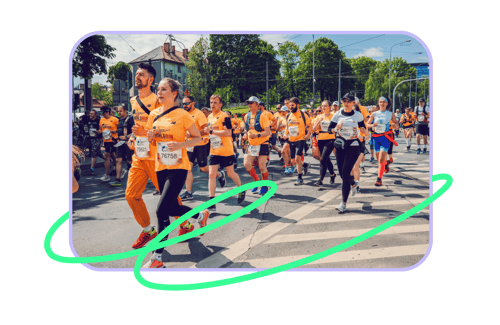
Physical activity quickly creates shared emotion. It puts participants in a different state from the office mindset and temporarily flattens hierarchy. Formats range from a one-off tournament to a connected challenge lasting several weeks. The latter has a decisive advantage: everyone contributes at their own level, which includes those who avoid head-to-head competition.
Creative and cultural team building
These formats spark imagination and open new conversations. Painting, cooking, or improvising forces people out of professional habits. They suit teams especially well when they want to work on speaking up, listening, or handling the unexpected.
Digital and remote team building
It answers a structural reality: remote work, dispersed teams, field staff. The principle is to offer a shared experience via mobile or web, with no constraint of location or single schedule. Done well, it does not replace in-person time; it extends it between two gatherings.
Solidarity and CSR team building
Here collective energy serves a cause outside the company. Teams live a powerful experience while the company anchors its social responsibility commitments in concrete action. This type of activity resonates particularly with employees looking for meaning.
18 team building ideas organized by category
Here is an operational selection. Each idea spells out the principle and the context for using it.
Sports and challenge ideas
Creative and cultural ideas
Digital and remote ideas
Solidarity and CSR ideas
How to organize digital or hybrid team building
The central challenge is avoiding two categories of employees: those who take part and those who watch. Six steps secure the outcome.
To dig deeper into the permanent dimension of social connection, our page on our approach to cohesion details this framework.
The connected challenge: team building that lasts
An event lasts a day. A connected challenge lasts three to six weeks and turns participation into a habit.
This is the core of the United Heroes app. Challenges form the central engagement mechanic: teams take on shared challenges, whether physical activity, well-being, or solidarity, and track their progress on a shared leaderboard. Streaks, daily series inspired by learning apps, encourage everyone to come back each day. Events add short, festive activations that punctuate the year: special weeks, world days, internal highlights. On the management side, the Client Portal gives HR teams a complete back office to configure programs, segment populations, and monitor results.
Three strengths explain why large organizations adopt it. The format natively includes remote and field teams, since everything runs through mobile. Duration creates habit where an event creates memory. Measurement is built in: you track participation and progress without adding tools.
The app is B Corp certified and ISO/IEC 27001 certified, and ranks in the top 15% of the Greenly assessment for its carbon footprint. More than 1,000 organizations across 150 countries use it, representing nearly 3 million users. Companies such as Paris 2024, Capgemini, Decathlon, and MAIF count among its public references. Find concrete illustrations in our client cases.
The promise fits in four words: the collective in action.
How to measure the impact of team building
Without measurement, team building remains a good-mood expense. Four indicators are enough to make the effort tangible.
- Participation rate. Compare sign-ups with actual participants. A wide gap signals an accessibility or communication problem, not necessarily disinterest.
- Completion rate. On a spread-out challenge, measure the proportion of participants still active halfway through and at the end. This is the best indicator of genuine buy-in.
- Verbatims. Collect a few short reactions right after the event, then again a month later. The second round reveals what survived the initial excitement.
- Managerial signals. Spontaneous initiatives between departments, requests for help, applications for the next editions. These qualitative observations complement the hard numbers.
Always proceed in two stages. Establish a baseline before the program, then compare several weeks afterwards. Judge a cohesion effect on the trend, not on the next-day peak of enthusiasm.
FAQ
What is the difference between team building and a simple team outing?
A team outing relaxes; team building pursues a defined objective. The outing can be limited to a meal or an evening, with no particular intention. Team building chooses a format based on an identified need: communication, trust, integration, or cooperation. It also fits into a continuum, with reference points before and after the activity. The two are not opposed, but only the second can be managed.
What budget should you plan for team building?
The budget depends on three variables: number of participants, duration, and chosen format. An internal activity run by a manager costs mainly organization time. A day run by an external provider represents a significantly larger investment. Connected formats sharply cut logistics costs, travel, rental, catering, especially with dispersed workforces. Always request several comparable quotes before deciding.
How often should you organize team building activities?
Regularity beats intensity. One big annual event creates a memory; a small monthly activation creates a habit. Many organizations combine both: one highlight per semester and light formats in between. Multi-week connected challenges fill this intermediate space usefully. Check your internal calendar and avoid periods of heavy operational load.
How do you involve reluctant employees?
Start by understanding the reluctance rather than sidestepping it. Some dread the spotlight, others the physical activity, others still the time taken from their personal lives. Offer varied formats and different roles: participant, organizer, photographer, referee. Make participation attractive without making it mandatory, because obligation destroys exactly what the activity tries to build. One visible early success often wins over the skeptics.
Is remote team building really effective?
Yes, provided you respect its own rules. The classic mistake is filming an event designed for in-person attendance and calling it hybrid. A good remote format starts from mobile, works asynchronously, and creates a common thread among all participants. It excels at maintaining connection between two physical gatherings. Teams that alternate rare in-person time with frequent digital activation generally get better results than those betting everything on one annual seminar.

Product Marketing Manager at United Heroes